
Introduction
IDEA StatiCa Connection is one of the most versatile structural analysis tools available, and its flexibility is one of the main reasons I rate it so highly. Traditional design software generally allows modification of only a limited set of parameters: member sizes, weld dimensions, bolt sizes, and perhaps the thickness of a stiffener or plate here and there. While this level of functionality is adequate in many cases, it can be restrictive when dealing with real-world conditions. Structural connections are rarely identical, and too often assumptions are made simply because engineers do not have the tools to model the connection exactly as it exists in practice. As structures are pushed closer to their performance limits, the ability to capture these nuances becomes essential.
With this flexibility, however, comes the responsibility to model scenarios accurately. An incorrect assumption or overlooked contact can significantly alter results. In this blog, we will explore one such case: a beam resting on a cleat-like element (referred to here as a “beam rest”) while being welded to a column. The purpose of the beam rest is primarily to aid alignment and simplify site welding, but structurally it also provides vertical translational support. If this support is not explicitly modelled, the beam rest will appear to function merely as a stiffening plate for the column, which is not an accurate reflection of reality.
Model Without Contacts
The first model demonstrates a beam welded to a column, with a beam rest positioned below it. In this case, no contact between the beam and the beam rest has been defined. The beam rest itself is connected to the column by four bolts, making it a secure but independent element.
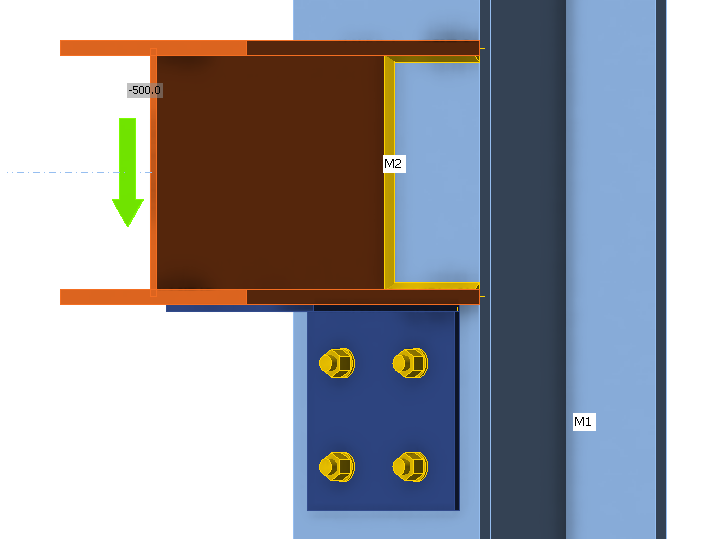
When a downward load is applied, the expectation is that the beam rest would resist some of the vertical displacement of the beam, thereby providing partial translational support. However, once the analysis is run and the deflected shape is examined, it becomes clear that the beam rest provides no such resistance. Without explicit contact modelling, the software does not interpret any interaction between the beam and the beam rest.
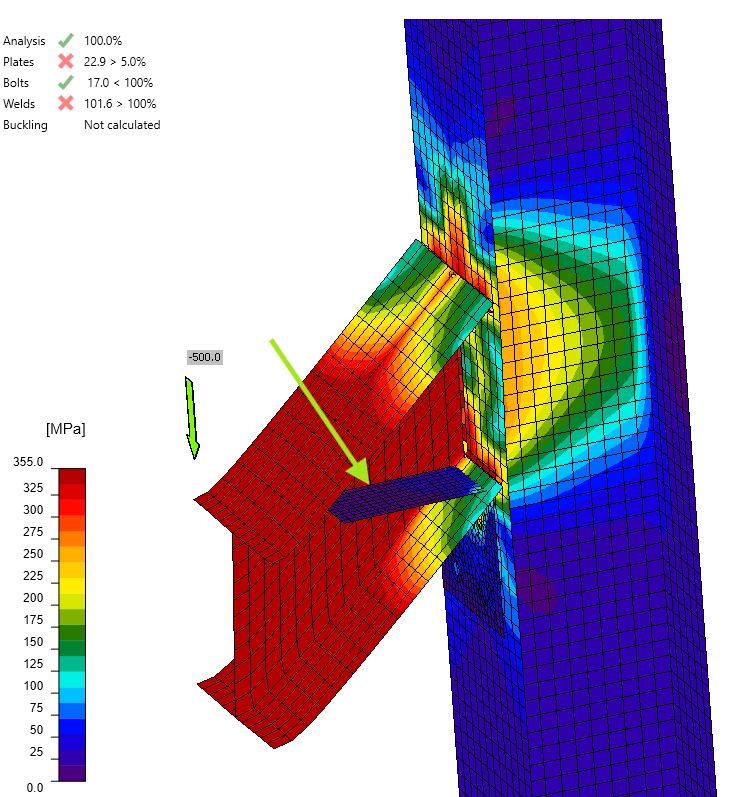
Model with Contacts
To reflect reality more accurately, the second scenario includes contact definitions. This requires adding a series of Operations—typically three to define the visible edges between the beam and the beam rest, and possibly a fourth for the contact surface against the column.
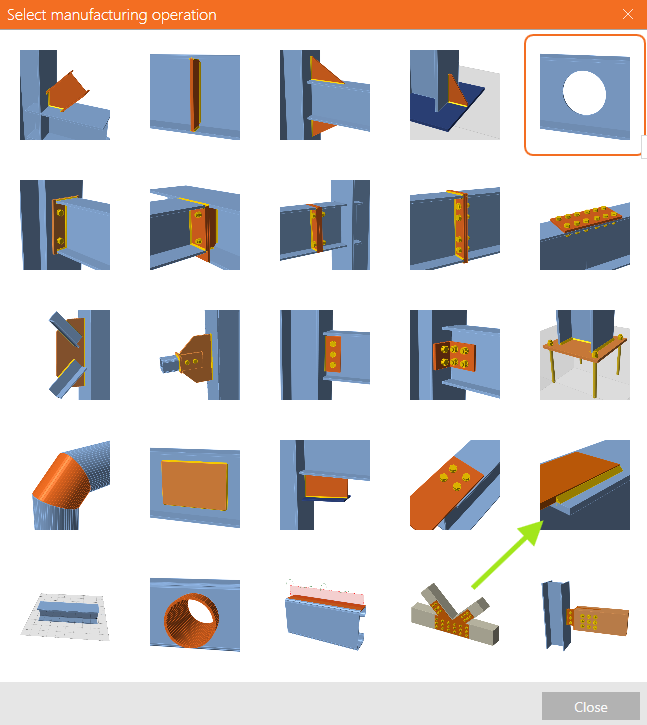
The default setting for such an Operation is “Weld,” but in this case it must be changed to “Contact.” From that point onward, the process is similar to defining welds.
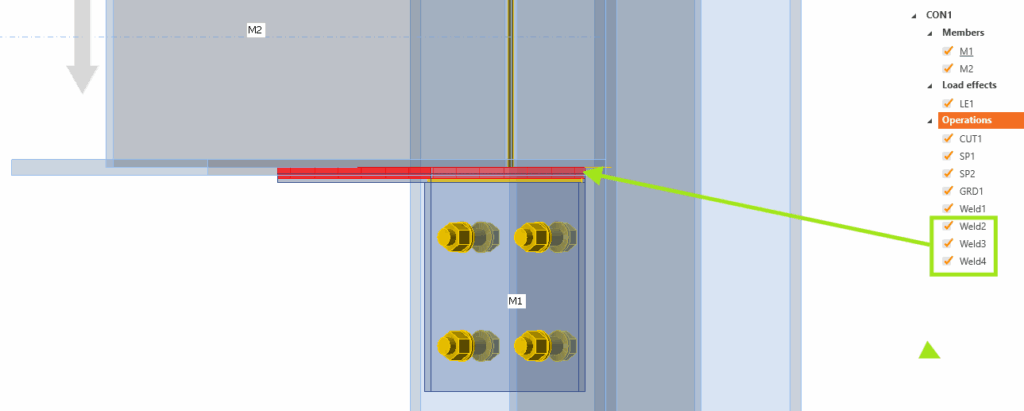
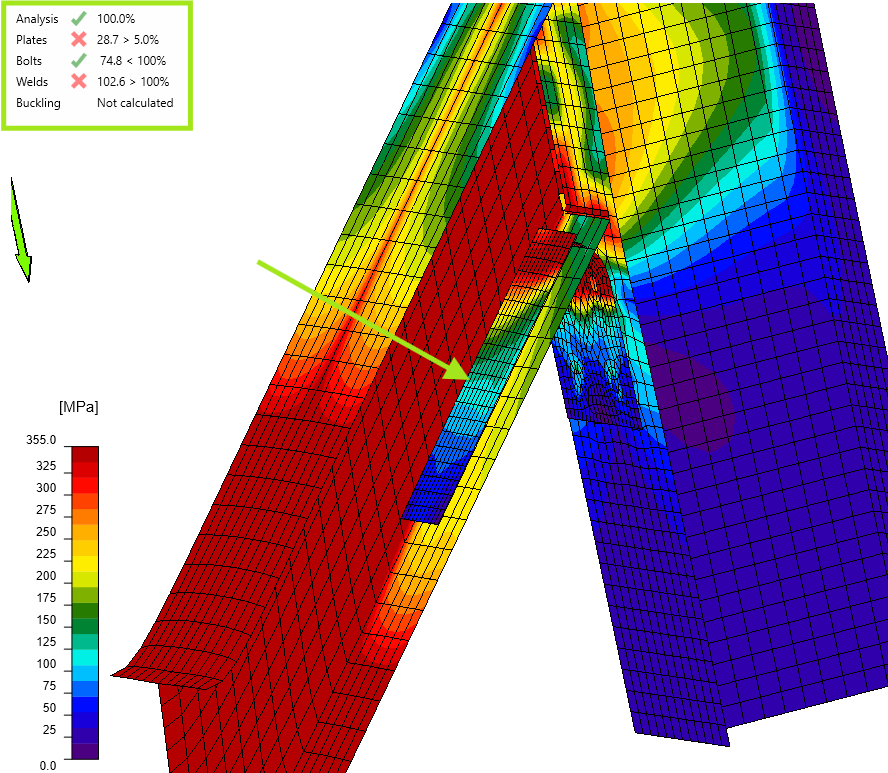
Running the analysis again produces results that differ noticeably from the first scenario. The deflected shape changes, indicating that the beam rest is now engaging structurally. More importantly, the overall performance of the connection worsens: plastic strain increases slightly, bolt utilization rises significantly, and weld utilization increases as well. Far from being negligible, the contribution of the beam rest introduces additional stresses that must be considered in the design.
Conclusion
This example highlights the importance of correctly modelling contact conditions in IDEA StatiCa. While the program’s flexibility is one of its greatest strengths, it also means that responsibility lies with the user to understand how each Operation affects the model. Simply adding a component to resemble reality is not enough—the interactions between components must be carefully defined to ensure the analysis captures actual structural behavior.
Ultimately, IDEA StatiCa allows engineers to go beyond simplified assumptions and represent the complexity of real-world connections. By doing so, we gain more accurate insights into how our designs will perform under load, and we are better equipped to strengthen connections where necessary. Flexibility without understanding can be dangerous; but flexibility paired with careful modelling is what makes IDEA StatiCa such a powerful tool in modern structural engineering.